中文简体
 Español
 عربى
A 30-inch gas range is the standard-width range built to fill a 30-inch gap between kitchen cabinets: roughly 29 7/8 to 30 inches wide, 25 to 27 inches deep at the body, and about 36 inches to the cooktop surface. It is the default size in North American kitchens, and it is also the size where two models with almost identical footprints can differ by several thousand BTU on the front burner and by half a cubic foot in the oven.
The short version of how to choose one: confirm the opening, the gas stub, and the hood first, then match burner spread and oven volume to how you actually cook. Most disappointments at this size come from installation surprises rather than cooking performance.
Content
- What a 30-inch gas range actually measures
- Burner layout: what four, five, or six burners actually buy you
- Freestanding, slide-in, or dual fuel
- Oven capacity and what changes inside the cavity
- Gas supply, venting, and clearance checks
- Running costs and how the two halves of the appliance behave
- What to verify before ordering in volume
- Frequently asked questions
What a 30-inch gas range actually measures
The 30-inch figure describes the appliance body, not the cabinet cutout, and the depth you read on a spec sheet usually excludes the handle and knobs.
A freestanding range slides into an open gap with cabinets on both sides, so the finished sides and backguard are part of the appliance. A slide-in range overlaps the countertop instead, which means the cutout is the number that matters. In both cases, the gas connection point behind the unit is what eats usable depth: a recessed gas box or a stub-out that sits too far forward can push the range out by an inch or more, leaving a visible gap at the counter edge.
| Measurement | Typical value | Why it matters |
|---|---|---|
| Overall width | 29 7/8 - 30 in | Bodies wider than the opening foul cabinet stiles |
| Body depth | 25 - 27 in, excluding handle | Handles and knobs add 2 - 4 in of projection |
| Height to cooktop | 35 1/2 - 37 1/2 in | Should sit level with or slightly above the counter |
| Gas connection | 1/2 in NPT, rear left or right | A proud stub-out reduces usable depth |
| Backguard height | 3 - 6 in above the cooktop | Limits clearance under a low window sill |
Two numbers deserve a second check: the height of the cooktop relative to the countertop, and the width of the door swing into a walkway. A 30-inch range with a wide oven door can block a narrow galley kitchen more than the width suggests.
Burner layout: what four, five, or six burners actually buy you
At 30 inches, four burners is the practical baseline; five- and six-burner layouts exist, but they gain positions mostly by shrinking the space between grates.
The useful comparison is not burner count but the spread of output. A well-planned 30-inch top puts one high-output burner for searing or a wok, two mid-range burners for everyday pans, and one or two low-output burners that can genuinely hold a simmer without scorching. Where budget models give themselves away is at the bottom of the range: a 15,000 BTU burner that cannot turn down below 1,500 BTU will scorch a tomato sauce no matter how good the top end looks.
| Position | Typical output | Best use |
|---|---|---|
| Front power burner | 15,000 - 18,000 BTU | Searing, wok cooking, stock pots |
| Front secondary | 9,000 - 12,000 BTU | Everyday saute and frying pans |
| Rear burners | 5,000 - 9,000 BTU | Sauces, rice, long simmers |
| Center or oval burner | 8,000 - 10,000 BTU | Griddle plates and bridge cooking on 5-6 burner tops |
Also look at the hardware around the flame: continuous cast-iron grates let you slide a heavy pan between burners, sealed burners wipe clean in seconds, and a thermocouple or flame-failure device cuts the gas if the flame blows out. Electronic ignition is standard now, but the spark module needs a 120V outlet within reach of the cord.
 Kitchen Digital Timer Control 6 Burner Cooker with Oven Grill Gas RangeKitchen Digital Timer Control 6 Burner Cooker with Oven Grill Professional Gas Range This product is a kitchen appliance that combines multi-function, high efficiency,...View Product →
Freestanding, slide-in, or dual fuel
Freestanding is the lowest-risk choice for a straight replacement, slide-in buys a flush front at the price of a tighter cutout, and dual fuel is worth the extra circuit only if the oven, not the cooktop, is the part you care about.
| Configuration | Oven | Installation | Fits best |
|---|---|---|---|
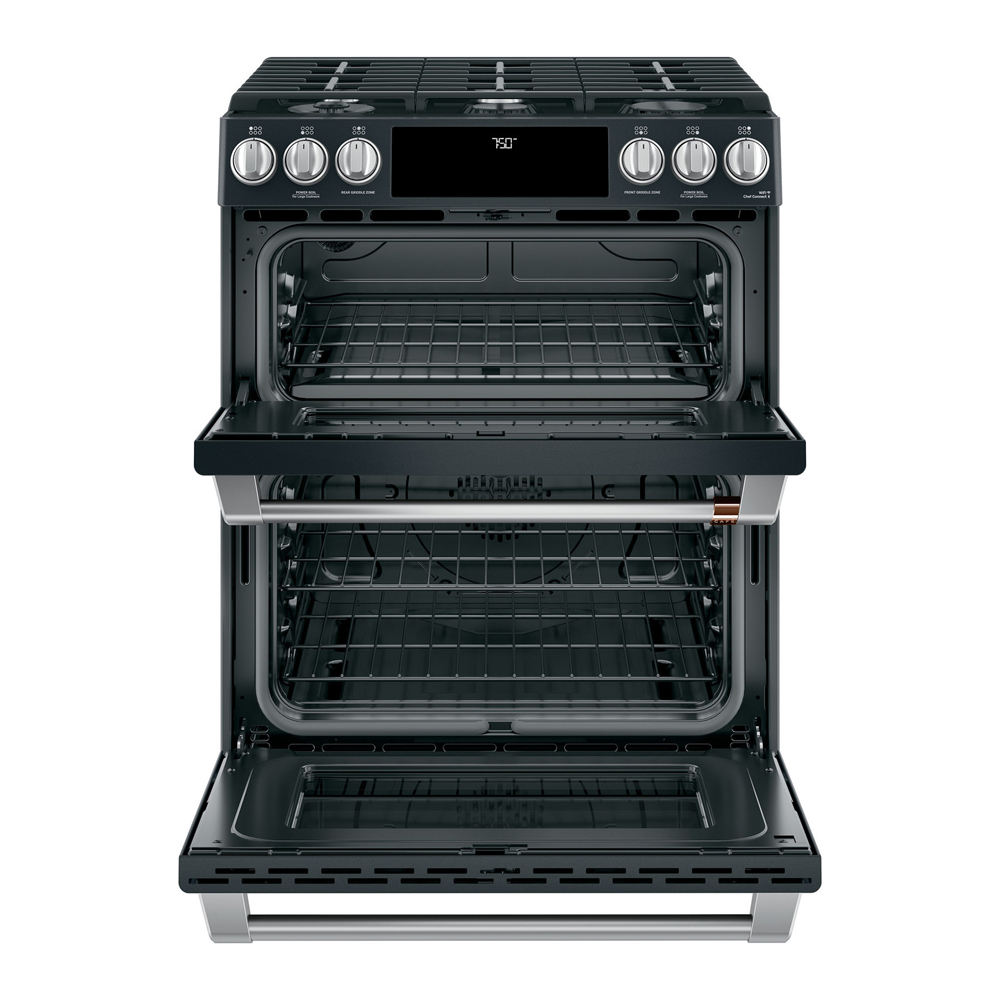
| Freestanding gas range | Gas oven, 3.5 - 5.5 cu ft | Slides between cabinets, finished sides, backguard | Replacements, rentals, quick turnarounds |
| Slide-in gas range | Gas oven, front controls | Overlaps the countertop, unfinished sides, tighter cutout | Remodels aiming for a built-in look |
| Dual fuel range | Electric oven, 240V circuit | Needs both a gas line and a dedicated 240V supply | Bakers who want tight oven temperature control |
One practical detail often missed: a slide-in model with front controls may block the drawer beneath it, and a freestanding model with a high backguard may not fit under a low window. Measure both before committing.
 30-Inch Freestanding Gas Range with Digital Timer and Baking OvenFreestanding 30-inch gas range with digital timer and built-in baking oven, relevant when checking fit and baking needs for home or small commercial kitchens.View Product →
Oven capacity and what changes inside the cavity
Most 30-inch gas ranges land between 3.5 and 5.5 cubic feet of usable volume, and that spread rarely comes from the outside dimensions.
Insulation thickness, burner placement, and whether the broiler sits in its own drawer or inside the cavity absorb the difference. When comparing models, these details tell you more than the headline capacity figure:
- Rack positions: five is workable, seven gives real flexibility for multi-tray baking.
- Convection: a fan-assisted oven browns more evenly on two racks at once.
- Broiler location: in-cavity broilers take up shelf height; drawer broilers keep the cavity intact.
- Storage drawer versus second oven: at 30 inches you usually get one or the other.
- Door glass and interior light: minor on paper, noticeable every evening.
Gas supply, venting, and clearance checks
Gas type, line size, and hood capacity decide whether the range can be installed as planned, so settle all three before the cabinets are cut.
- Gas type: natural gas and propane need different orifices and a different regulator spring. A propane kit is not a sticker on the box; the burners must be re-jetted and the output verified.
- Connection: a 1/2-inch NPT line with a shutoff valve in reach, a sediment trap, and a listed connector. Pipe size matters more than most buyers expect, especially with a high-output burner running.
- Electrical: spark ignition needs a 120V outlet; dual fuel needs a dedicated 240V circuit sized to the oven rating.
- Venting: a 30-inch range with a 15,000 BTU burner typically calls for a hood in the 300 - 600 CFM band, with more for wok cooking. Ducted beats recirculating in almost every case.
- Clearance: 30 inches between cooktop and hood is the usual figure, alongside the side clearances to combustible surfaces listed in the manual.
Safety detail is worth a mention because it is easy to skip: identifying a gas leak by smell is a skill every household using a gas range should have, and a proper installation with a tested connection is the first line of defence.
Running costs and how the two halves of the appliance behave
A gas cooktop usually costs less per hour to run than an electric one, while the oven side of the comparison flips on long bakes depending on local tariffs.
The reason is simple: burners convert fuel directly into heat under the pan, whereas an oven heats a large insulated box and loses efficiency through door glass and venting. The gap between the two widens further if your electricity price is high relative to gas. For the full comparison, including how the balance shifts with different tariffs and cooking habits, see this analysis of gas range versus electric range energy efficiency.
What to verify before ordering in volume
In volume buying, the specification sheet and the packing drawing move landed cost more than the burner count does.
For projects, rentals, and private-label programmes, the questions that decide a purchase order are narrow and practical:
- Which certification is required for the destination market, and is the gas train approved for it?
- Can the unit be supplied jetted for natural gas, propane, or both with a conversion kit in the carton?
- What are the exact packing dimensions and the container loading quantity, since a 10 percent change in carton size changes freight per unit?
- Are manuals, rating labels, and control panel artwork supplied in the destination language?
- What spare parts are stocked, and what is the warranty split between burner components and electronic controls?
Digital timer and electronic control boards are now common even on entry models, so confirm the control supplier and the spare board price at quotation stage rather than after the first container ships. Browse the full gas range lineup to compare freestanding, dual fuel, and luxury configurations side by side.
 Kitchen Appliance Digital Timer Control Pizza Electronic Slide-In Gas Range with OvenKitchen Appliance Digital Timer Control Pizza Electronic Slide-In Gas Range with Oven is an electronically controlled built-in gas stove equipped with an oven function...View Product →
Frequently asked questions
Will a 30-inch gas range fit an existing 30-inch opening?
Yes, if the opening is a true 30 inches and the body is 29 7/8 inches, leaving roughly 1/16 inch of play on each side. Measure the narrowest point of the opening, not the widest, and allow for baseboard or tile that narrows it.
Do I need a 240V outlet?
Only for a dual fuel model with an electric oven. Standard gas ranges use a 120V outlet for spark ignition, and many European-spec models use battery or low-voltage ignition.
Can a 30-inch gas range run on propane?
Yes, with the correct orifice kit and regulator spring. Output figures change after conversion, so the LP rating should be quoted separately rather than assumed from the natural gas figures.
How much clearance is needed above the cooktop?
A 30-inch gap to the hood is the common baseline, and combustible surfaces above the range need protection or a higher clearance as stated in the manual. Local code overrides the manual, so confirm with the installer.
What hood capacity suits a 30-inch gas range?
Around 300 to 600 CFM covers most 30-inch gas tops, with higher capacity if you regularly use a 15,000 BTU burner for wok cooking. Ducted installation with a short, straight run performs far better than a long, bendy one.